
Review: Mother Mary
What happens when we venerate celebrities as saints?

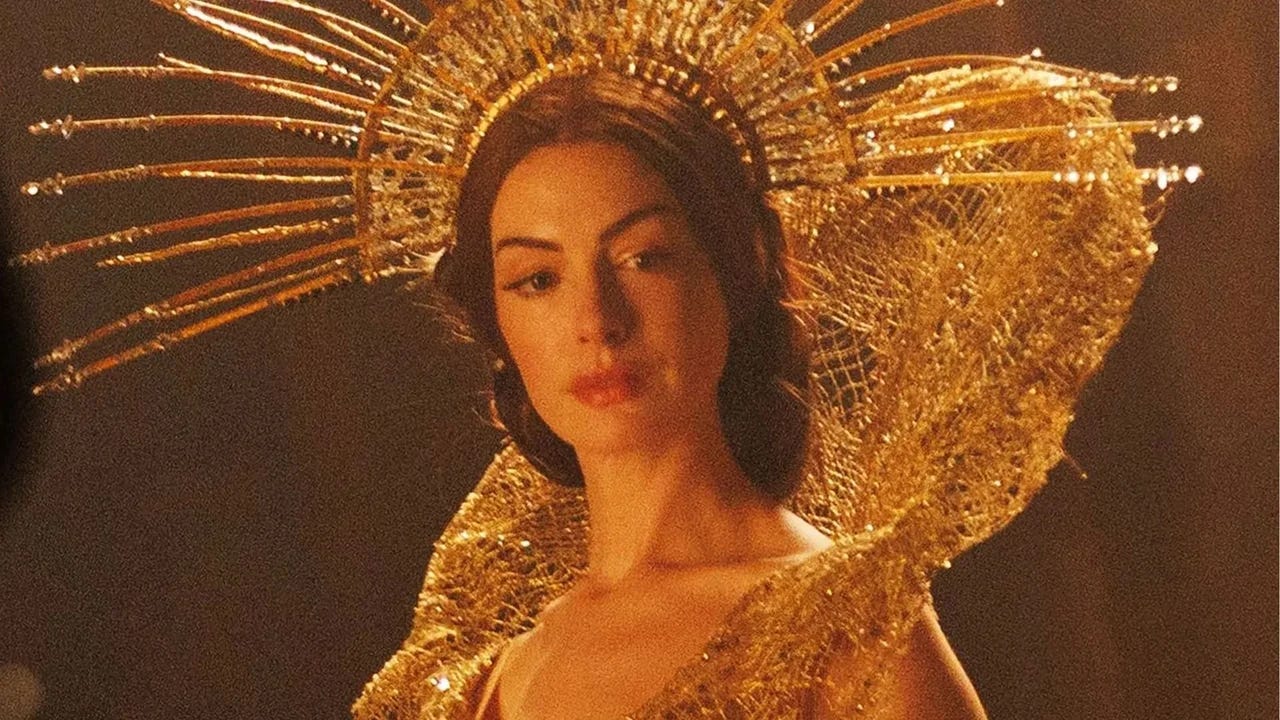
When the clearly distressed and tormented pop star Mother Mary (Anne Hathaway) shows up unannounced at fashion designer Sam Anselm’s (Michaela Coel) studio mansion, it’s obvious this won’t be a routine fitting and design.
We quickly gather that Mother’s desire for Sam to make her a new dress has an almost metaphysical significance to both of them. And as they begin the process of taking measurements, and comparing fabrics, they also start to unspool their complicated history as collaborators and friends, as well as the haunting dark-night-of-the-soul that Mother’s gone through since they last worked together.
David Lowery’s Mother Mary, excited me from the outset. An ethereal gothic pop-horror about something haunted that lies underneath the veneration of celebrity and the way artistic collaboration can both wound and heal? Sign me up. I’ve enjoyed much of Lowery’s work, most notably Ghost Story and The Green Knight, so a strange sort of blend of those two infused with the essence of Phantom Thread and Persona is exactly the kind of thing I should immediately fall in love with.
Unfortunately something about this never really clicked. What it ended up doing best was providing an example of how it takes more than a collection of compelling concepts to make an actually compelling film.
There are many flashes of set and costume design, editing, and performance that I found beautiful and engaging. An early piece of dance choreography, performed by Mother with no soundtrack but Sam’s reverent-yet-judgemental gaze, and the sound of her own limbs pounding and scuffling against the wooden floor of the old church (barn? castle?), is an inspired moment that showcases the way an artistic impulse can start to appear like a kind of possession. In other parts of the film, Mother’s performances on stage, and the moments leading up to and following those performances, employs staging, symbolism, and lighting that evoke a fusion of elements from medieval, baroque, and romantic religious art—making the way our culture treats celebrity as a kind of religious icon explicit. In other more horror-inflected portions of the film, the imagery approaches a kind of abstraction akin to what we’ve seen in the more daring portions of Under the Skin or Get Out.
All of that is beautiful and at times horrifying, yet I never found my bearings within the story. I could never figure out how relate to these characters, or what, exactly, all of it was trying to say. I’m often fine with movies that don’t check those boxes (like is the case with more than one David Lynch film—and not every movie needs to “say” something) but this moves forward in strange fits and starts that kept me from ever getting completely swept up in just the vibe alone and left me feeling like I was missing something.
The dialogue was the biggest discomfort. The performance of it was fine, with the cast working overtime to give it all dramatic weight, achieving impressive results at times, but they’re weighed down by overladen, poetic language that doesn’t quite amount to much. I’m paraphrasing here, but exchanges like:
“I’m stubborn you know.”
“Yes you are.”
“I mean I don’t change easily.”
—just left me a baffled. One character says and then re-states the same thing, and the other just agrees? It’s the kind of thing I’d give a note on if I saw it on the page. Many such cases. Mother and Sam mostly seem to be talking at each other and we learn very little about who these women are or what’s going on with them besides what they explicitly tell us. I’m fine with a chamber piece (Persona is a favorite), but there’s ways of showing and revealing things about the characters through the dialogue that don’t involve them just telling us their personality traits. I’m also perfectly fine with floral dialogue, where the words are mostly there for the lush texture of their own sound when the occasion warrants it, but this didn’t feel like that. It felt like it a hand trying to scratch an itch on my back that it never found.
In the end the movies is much more effective when the dialogue falls away and it shifts into an entirely different register, where it’s carried by the boldness of the aesthetic, and lets the images do the talking.
Still, it felt worth the time investment, and I don’t mean to come across as harsh. I’d happily try this again another time to see if it strikes me differently. I think I’m left picking-nits because wanted to like this much more than I did, even more so thanks to the particularly powerful turn from Hathaway, how bold of a swing the evocative visuals are, and the way it explores the cost of venerating celebrities—so I’m left feeling around for why this didn’t work for me.
At its core it taps into a powerful idea, that if we treat someone as an enchanted being, it inevitably opens up a door for them to be haunted, something I believe is at least metaphorically true. But while the basic structure of this theme is sketched out, we never get to see it explored with enough detail to learn anything about that double edged sword, what it says about us as humans, or how we might wield it.
I haven't seen it, but this review is fascinating. You're describing a film that sounds gorgeous and frustrating in equal measure.
The "hand scratching an itch it never finds" is painfully vivid. I've felt that. Might skip this one. Or maybe I'll watch it just to see what you mean. I broke a leg three weeks ago, and I have alot of free time now.